
That's Moab
“That's a lot of rocks”
Abigail Edwards
In the winter of 1933 and spring of 1934, an expedition, led by
Frank Beckwith of Delta Utah, conducted a reconnaissance survey for
the Department of the Interior to inventory and assay the natural
and scientific resources found within and nearby the recently
established Arches National Monument. Joeseph C. Anderson was
engaged to study the geology of the monument and deliver a detailed
report to officials at the Department of the Interior. The following
is a transcript of the official report.
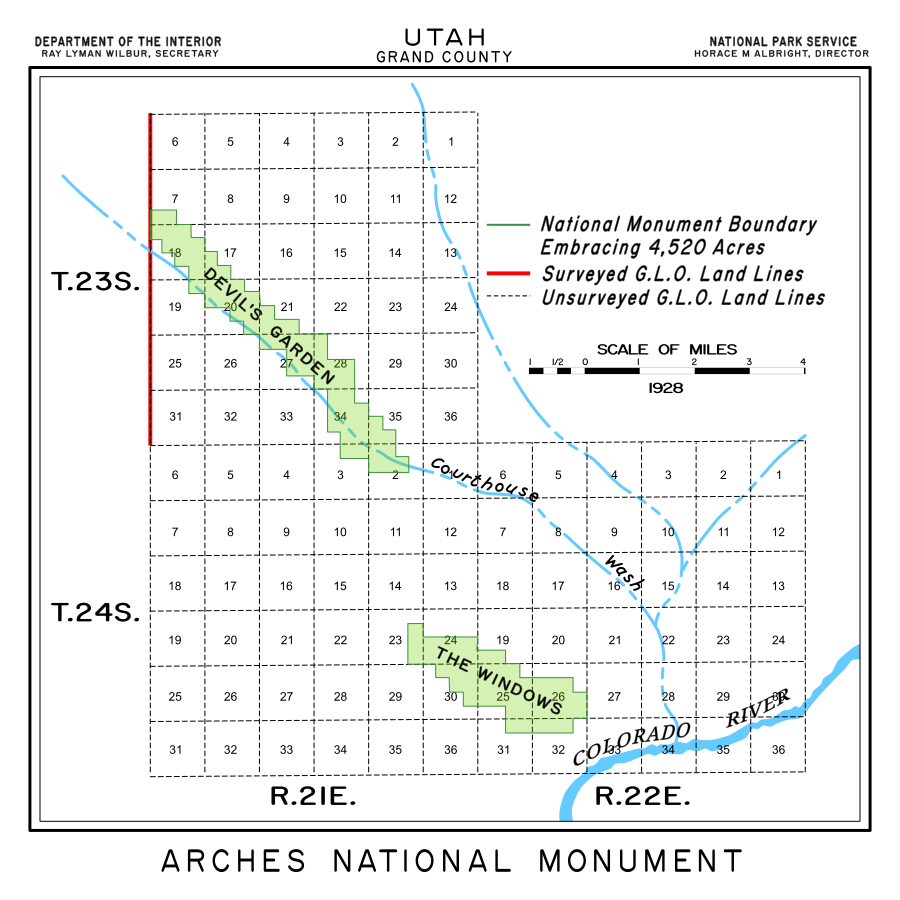
GEOLOGIC RECONNAISANCE IN THE ARCHES NATIONAL MONUMENT
by Joseph C. Anderson
page 1
INTRODUCTION
The Arches National Monument, consisting of three closely related
areas, covering approximately 7500 acres of land is located in the
south central part of Grand County, Utah.
Situated as it is in the disturbed area flanking the La Sal
Mountains the National Monument is difficult to reach as only
low-grade desert roads lead from the main highways into the
vicinity, and from the ends of these long hikes or horseback trips
are required to reach the attractions in the monument proper. For
this reason very few people outside of the nearby settlements are
acquainted. with the spectacular erosion forms to be seen, which
consist of numerous sandstone arches, cliffs, pinnacles, vertical
slabs and bad-land erosion. Moab which 12 the nearest town, and the
County seat of Grand County lies about eight miles south.
The present investigation was begun in December 1933 and completed
in April 1934, as a project, with appropriation from the Federal
Civil Works Administration, and under the direction of the National
Park Service through Zion National Park.
page 2
Instructions required reconnaissance investigation in Archaeology,
topography and geology. For the purpose of this report the results
of geologic reconnaissance only will be treated.
PREVIOUS WORK
While there is no published work on the Arches, parts of the region
have been covered by several different publications. The most recent
reports on the area and those covering the immediate vicinity came
as a result of the oil prospecting activity around Moab in recent
years.
PROCEEDURE
Geologic reconnaissance and mapping was conducted during parts of
two eight week periods. Daring the first term of work, mapping was
done by triangulation, with plane-table and telescopic alidade, from
a measured base-line. Drainage and formation contacts were sketched
from stations thus located. Work the second eight weeks was greatly
facilitated by the aid of a rodman, when a long stadia traverse was
run nI some detail mapped by stadia observations. since no bench
mark was available in the area it Was necessary to assume a
base-line elevation and carry vertical control from there on 1y
vertical angles.
page 3
PHYSICAL CONDITIONS
The topography varies radically over different parts of the area,
each of the three divisions having distinct characteristics. The
section known as The Arches is a northeast - southwest trending
stringy; of narrow mesa rock lands dropping, off to steep cliffs on
all sides, and the tops of the mesas are inaccessible because of the
vertical walled cliffs which are in no place cut low enough for
ascent. Around the cliff mesa lands are low rolling sandstone hills
which on the north side break off and dip moderately toward the main
drainage in that direction known as Salt Wash. (See Fig. 2)
Situated along the north rim of the Salt Valley Anticline (See Fig.
1) is the area known as The Devil's Garden, where the massive
sandstones have been fractured and eroded into long rib-like slabs
which stand closely spaced and at times alone in low sandy flats.
These vertical slabs attain heights estimated at 350 feet.
The Yellow-Cat section presents an entirely different aspect. Here
high buttes are weathered into typical badland forms. The greatest
difference in elevation at this place amounts to more than 500 feet.
(See Fig 3)
page 4
The vegetations is in keeping with the climate of the area which is
arid. Black brush, junipers and the two-needle pinion represents the
most abundant of the vegetation, though there are occasional chimps
of cottonwood, scrub oak and willows where conditions are favorable.
There is one characteristic and unique tree that deserves special
consideration. In the summer it dots the landscape with patches of
bright green -- it is the single-leafed ash (Fraximus anomola). In
protected places where over-grazing by sheep has not exterminated
them, there are numerous flowering annuals of brilliant and varied
hues. And, of course, there is the usual large number of cactus and
yucca characteristic of desert regions. (:gee Fig. 4)
STRATIGRAPHY
Due to the almost total absence of fossils in the rock formations of
the Arches National Monument, the stratigraphy has been determined
almost entirely on stratigraphic position and lithology. The oldest
rock formation in the area is Triassic Chinle, which is exposed in
the bottom of Salt Wash in the east end of the Arches area, where it
forms a steep slope from the base of vertical Wingate cliffs to the
bottom of the canyon. Above the Wingate which was not measured, but
page 5
estimated at 250 to 300 feet, occurs a series of lavender colored,
coarse grained sandstones and some thin shale beds that form a
stepping platform up to the base of the Navajo Sandstone. This
sandstone has been identified as the Kayenta formation because of
its lithologic characteristics and position between two easily
identified formations. Its thickness was estimated at 225 feet.
The Navajo Sandstone which forms the gently sloping platform on
which the arch-building formations rest is a light cream to buff,
heavily crosbedded formation whose thickness was determined by
alidade observations at 390 feet.
The contact between the Navajo and Carmel formations was chosen
where the cream colored sands change definitely to the deep
brown-rod color, characteristic of the Carmel sediments. This
formation while not measured is 60 to 70 feet thick, and exhibits a
crinkly condition that as yet has not been explained. The crinkling
has distorted the overlying Entrada Sandstone and makes any definite
contact difficult to define.
It is impossible to measure exactly the thickness of the Entrada
Sandstone in the area, but a close calculation from alidade
observations indicates that there is 380 feet exposed at the Arches
and at the Devil's Garden.
page 6
The formation is massive, generally buff cross-bedded sandstone,
differing, from the Navajo in that it is a darker buff with
cross-bedding much less extensive and sweeping in character.
Numerous small cavities occur along bedding planes and give a
honeycombed effect to the surface of an exposure. (See Fig. 5) The
upper 50 or 75 feet of this formation is white, coarser grained,
unevenly cemented sandstone.
Resting on the slightly undulating surface of the Entrada Sandstone
is the Summerville formation, a thin gritty shale 32 feet thick,
composed of alternate layers of red, greenish and white shale and
impure sandstone. Measurement of the formation was made with a
hand-level some three miles west of Willow Springs in the unsurveyed
area of T S, R 21 E. The Summerville occurs as a thin band in the
topography below heavy ledges of Salt Wash Sandstone and above long
gentle platforms of Entrada Sandstone, or as long snaky ridges on
the Entrada which forms the "slick-rock" bench around Willow Springs
and southeast and west of Yellow-Cat Knolls.
The Morrison formation composed of sandstone and shales, is exposed
in the Yellow-Cat district to the extent of 500 feet. The lower
part, essentially layers of heavy cross-bedded, often conglomeritic
sandstone with
page 7
occasional shale breaks is known as the Salt Wash member of the
Morrison. The upper shale beds are variegated gray, green, lavender
and pink, eroded into intricately complicated topographic designs.
The formations just described of Morrison age contain abundant
fossil remains of dinosaur bones. Known bone deposits occur within a
hundred feet of the base and range some 300 feet above. Eroded
fragments of silicified bone occur widely over the surface and in
places are so thickly strewn as to almost completely cover the
ground. Embedded bones occur one or two at a place and do not seem
to be with a complete skeleton, but there is little doubt that
careful search would disclose more or less complete deposits.
The Dakota sandstone and younger formations have not been identified
within the boundaries, but occur in close proximity to the north end
of the Yellow-Cat section and on the east end of the Devils Garden
where the formations dip steeply and fault, throwing. beds of Mancos
shale in contact with the Chinle formation.
STRUCTURAL RELATIONSHIPS
The warping and folding that accompanied the uplifting of the La Sal
Mountains is no doubt the cause of the structural relief that made
possible the unique erosional forms to be seen in the area. The
Arches are located on the north flank of the Courthouse Syncline,
page 8
on the west side of the Colorado River. The rocks dip gently to the
westward and to both sides forming an open anticlinal structure
rising toward the nearby mountains. At the west end the dips
abruptly change , reverse their trend and become a part of the Salt
Valley Anticline Structure.
The Devil's Garden owes its grotesque erosion forms directly to the
fracturing or vertical jointing of the massive Entrada Sandstone in
the course of the formation of the Salt Valley uplift. The jointing
parallels the long axis of the anticline and gradually disappears
down dip toward the synclinal closure. Running water was not a
factor in the formation of the arches and natural bridges found in
these two areas as was the case in the White Canyon to the south.
Wind erosion, aided by the weather ink; of the rock due to moisture
and temperature changes, seems to have been the primary factors in
seeking out soft and loosely cemented spots and working them through
to large natural arches. In the Devil's Garden a huge hole was bored
through a thick massive sandstone slab with the wind, rain and frost
as the only apparent tools used in its carving. (See Fig. G)
page 9
The large arches, or windows as they are sometimes called, found in
the Arches section are not so hard to explain because of their
occurrence in the more easily weathered Carmel formation with the
massive Entrada Sandstone capping. A freak of natural erosion forms
is found in the formation of a double arch, Rising from a common
base, two long delicate arms at right angles to each other reach to
the nearby cliff. A short distance away two large windows have been
carved through the cliffs -- massive and heavy. No less remarkable
is the carving of the high rock mesas in which 1;he arches occur.
Long fingers of rock, deep gorges and channels with irregularly
carved sides.
The Yellow-Cat Knolls composed, as they are, of shale and easily
eroded grit are located in a structural depression, and being
protected from weathering because of their structural position have
persisted and withstood the erosion that is gradually stripping
these softer formations from the slick-rock bench.
ECONOMIC GEOLOGY
Though nothing of economic value is being produced from the Arches
National Monument or immediate vicinity, a consideration of economic
possibilities is important because of the active prospecting in the
vicinity for gas and oil. Should a productive oil horizon be found
page 10
in the Salt Valley Anticline, a large part or all of the National
:Monument would become favorable for oil production because of its
close relationship to that structure. The Yellow-Cat district has
been actively worked for Vanadium ore which occurs in the Salt Wash
Sandstone, but mining operations ceased a few years ago when larger
more .easily processed deposits made production here unprofitable.
The Paradox formation of Pennsylvanian age, exposed in Salt Valley,
is known to contain salt, gypsum, and some potassium salts. The
results of core drilling conducted in the valley are not known.
************
Contact info:
This website is copyright 1998-2025 by Mike McCue Moab Utah USA